
Georgia Tech plays a vital role in advancing space exploration through its diverse portfolio of past and ongoing missions. From pioneering nanotube technologies for nanosatellites to developing innovative antenna systems deployed on the International Space Station, our researchers are at the forefront of cutting-edge aerospace innovation. The missions highlighted below showcase the impactful contributions of Georgia Tech faculty, students, and researchers across the spaceflight community.
VISORS
Launch: TBD
Target: Sun
The VISORS mission, Virtual Super-resolution Optics using Reconfigurable Swarms, is a multi-university cubesat mission aimed at capturing high resolution images of the sun. Georgia Tech is working on this mission in conjunction with Perdue University.
SWARM-EX
Launch: 2024
Target: Earth
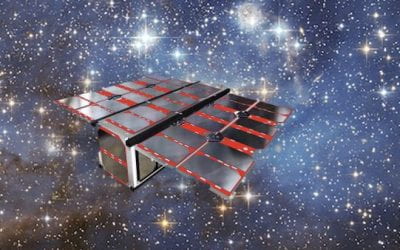
SWARM-EX, Space Weather Atmospheric Reconfigurable Multiscale Experiment, is a large project sponsored by the National Science Foundation. Six Universities in total are working on this project. They include: Georgia Tech, Olin College, Stanford University, University of South Alabama, and Western Michigan University.
BioSentinel
Launch: 2022
Target: Moon
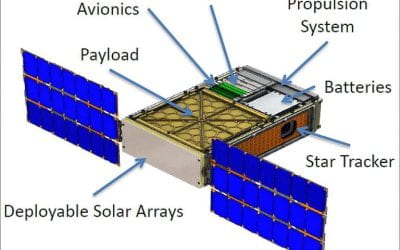
BioSentinel is a life science CubeSat mission that will be the first in over forty years to obtain direct experimental data from biological studies occurring beyond Low Earth Orbit. The BioSentinel is designed to measure the damage and repair of DNA in a biological organism and compare that to information from onboard physical radiation sensors.
MISSE-15
Launch: 2021
Target: Earth
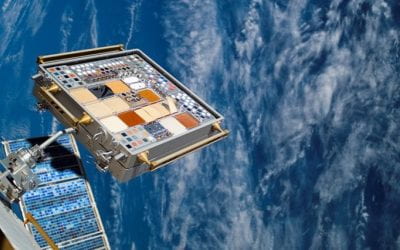
MISSE-15 is an external craft within the MISSE series aimed at testing various materials in the harsh environment of space. The crafts include ram, wake, zenith, and nadir exposures. (These are coordinate axes in the spacecraft-centered coordinate system.)
GT-1
Launch: 2021
Target: Earth
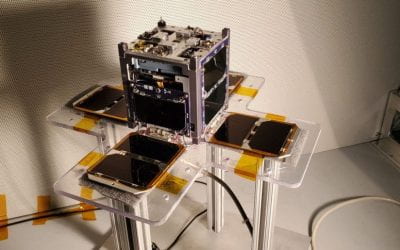
GT-1 is the first of four in a series of 1U CubeSats to be developed by Georgia Tech annually. GT-1 contains experimental deployable solar panels and a deployable UHF radio antenna. This mission demonstrates a rapid lifecycle of a university level CubeSat.
Lunar Flashlight
Launch: 2021
Target: Moon
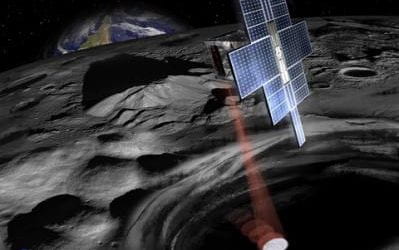
The Lunar Flashlight mission consists of a solar-powered 6U CubeSat whose objective is to search the lunar poles of the moon for water ice and other volatiles. Georgia Tech’s Space Systems Design Laboratory (SSDL) is designing and building a new green propellant propulsion system that will perform orbit insertion for NASA’s Lunar Flashlight.
OrCa
Launch: 2020
Target: Earth
The Challenge:
- Optical observations of resident space objects (RSOs) are typically conducted by leveraging ground and space-based telescopes as well as all-sky imagers
- Most observations are unresolved images – creating difficultly in determining RSO behavior such as pose estimation and health and de-conflicting closely-spaced objects
MISSE-11
Launch: 2019
Target: Earth
MISSE-11 is an external craft within the MISSE series aimed at testing various materials in the harsh environment of space. The crafts include ram, wake, zenith, and nadir exposures. (These are coordinate axes in the spacecraft-centered coordinate system.)
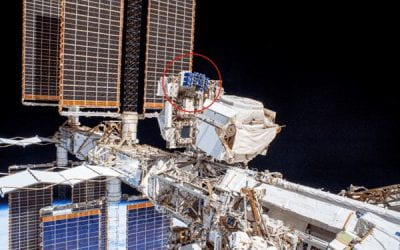
MISSE-12
Launch: 2019
Target: Earth
MISSE-12 is an external craft within the MISSE series aimed at testing various materials in the harsh environment of space. The crafts include ram, wake, zenith, and nadir exposures. (These are coordinate axes in the spacecraft-centered coordinate system.)