
Location: The Historic Academy of Medicine
Address: 875 W Peachtree Street NW, Atlanta, GA 30309
Attire: Business Casual
Agenda details and timing are subject to change. Please continue to check back for the latest updates.
| Time | Agenda |
|---|---|
| 8:30 – 9:00 a.m. | Registration and breakfast |
Building the Future Space Workforce
Session Organizer: W. Jud Ready, Georgia Tech Space Research Institute
| Time | Agenda |
|---|---|
| 9:00 – 9:30 a.m. | Invited Keynote: NASA Aerospace Skilled Technical Workforce Hubs Elaine P. Ho, Associate Administrator NASA Office of STEM Engagement |
| 9:30 – 10:15 a.m. | Fireside Chat – Southeast Space Technology & Aerospace Readiness Skills (SE-STARS)
|
| 10:15 – 10:30 a.m. | Break |
| 10:30 – 11 a.m. | Southeast Analogs: Creating an Accessible Path to Space Bella Diedrich and Gabriel Buggi, Georgia Tech |
Invited Keynote
| Time | Agenda |
|---|---|
| 11 a.m. – 12 p.m. | Jeanette J. Epps, NASA Astronaut |
| 12 – 1 p.m. | Lunch |
Terrestrial and Space Weather
Location: Academy of Medicine upper level
Session organizer: Michael Peterson, Georgia Tech Research Institute
| Time | Agenda |
|---|---|
| 1 – 1:30 p.m. | NASA’s History of Spaceborne Lightning Detection Patrick Gatlin, NASA Marshall Space Flight Center |
| 1:30 – 1:45 p.m. | VLF/LF Radio Waves: How They Connect So Much of Earth and Space Sciences Morris Cohen, Georgia Tech |
| 1:45 - 2 p.m. | Geostationary Satellite Measurements Reveal that the Gulf and Adjacent Maritime Regions Including South Georgia have the Highest Flash Rate Thunderstorm Cells on Earth Chloe Knight, Florida State University |
| 2 – 2:15 p.m. | Non-Lightning Emitters in Geostationary Lightning Mapper Yufei Li, Georgia Tech |
| 2:15 – 2:30 p.m. | Break |
| 2:30 – 2:45 p.m. | From Space Weather to Mission Assurance: AI-Driven Prediction of Satellite Anomalies for Resilient Space Operations Srikanth Kodeboyina, Blue Eye Soft Corp |
| 2:45 – 3:00 p.m. | SkyCT: Enabling Space-Based Technologies from Earth Matthew Strong, Georgia Tech |
| 3:00 – 3:30 p.m. | Severe Weather Lightning Signals as a Space-Based Sensing Opportunity for Space Weather Ionospheric Effects — the FulminoSat Concept Michael Peterson, Georgia Tech Research Institute |
Exploration: Other Topics in Space
Location: Academy of Medicine upper level
Session Organizer: Jud Ready, Georgia Tech Space Research Institute
| Time | Agenda |
|---|---|
| 3:30 – 3:50 p.m. | Restartable Pulse Plasma Propulsion Using Ionic Liquid Conducting Polymer Propellants for Small Spacecraft Alejandro L. Briseno, The Aerospace Corporation |
| 3:50 – 4:10 p.m. | Planetary Regolith Dynamics and Exploration of Metallic Asteroids Anmol Sikka, University of Maryland |
| 4:10 – 4:30 p.m. | Passive Microwave Remote Sensing for Lunar Exploration Mustafa Aksoy, University at Albany, State University of New York |
| 4:30 – 4:40 p.m. | Break |
| 4:40 – 5:00 p.m. | Bistable Reflectors for Attitude Control of Power-Beaming Satellites Gregory D. Durgin, Georgia Tech |
| 5:00 – 5:20 p.m. | Galaxy in a Haystack: Finding Hosts of Merging Massive Black Hole Binaries Tamara Bogdanovic, Georgia Tech |
Hypersonics
Location: Academy of Medicine lower level
Session Organizer: Krishan Ahuja, Georgia Tech
| Time | Agenda |
|---|---|
| 1 – 1:10 p.m. | Session Introduction |
| 1:10 – 1:30 p.m. | High-Hypersonic Flight enabled by the New Space Economy: Expanding Hypersonic Capabilities Stef Crum, Reditus Space Inc. |
| 1:30 – 1:50 p.m. | HyperSat: An Innovative, High-Cadence, Hypersonic Flying Testbed of Georgia Tech Krishan Ahuja, Georgia Tech |
| 1:50 – 2:10 p.m. | Development of Experimental Hypersonic Test Capabilities at Georgia Tech Research Institute Michael Milone, Georgia Tech Research Institute |
| 2:10 – 2:30 p.m. | Hypersonic Computational Fluid Dynamics at GTRI Alexander Forbes, Georgia Tech Research Institute |
| 2:30 – 2:45 p.m. | Break |
| 2:45 – 3:05 p.m. | Overview of Hypersonic Aerothermal Common Research Model Activities Adam Cox, Georgia Tech |
| 3:05 – 3:25 p.m. | The Hypersonics Vertically Integrated Program at Georgia Tech Alex Ren, Georgia Tech |
| 3:25 – 3:45 p.m. | CFD-in-the-Loop Simulations of Entry Vehicles Bradford Robertson, Georgia Tech |
| 3:45 – 4:05 p.m. | A Lumped Model for Cryogenic Fuel Boil-Off Prediction under Varying Flight Operating Conditions Soomin Lim, Georgia Tech |
| 4:05 – 4:15 p.m. | Session Wrap-Up |
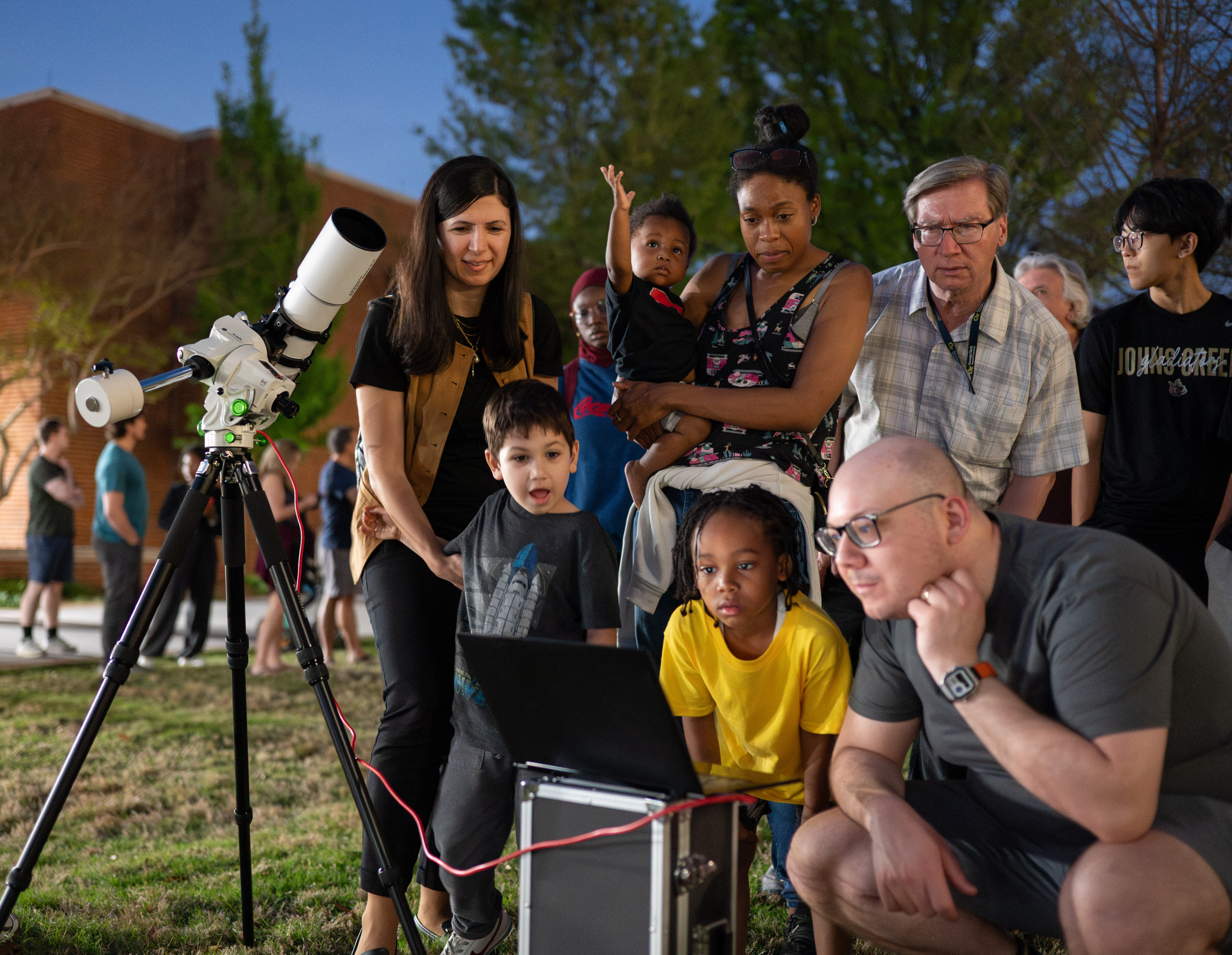
Public Observatory Night
The Georgia Tech School of Physics invites you to observe various bright celestial objects. These observing events are free and open to everyone.
Time: 8:30 – 10:30 p.m.
Location: Seven Bridges Plaza, 837 State St NW, Atlanta, 30332